
- Climate Risk Assessment
- Sustainability Service The global sustainability reporting landscape is undergoing a seismic shift, and India is no exception. As regulators, investors, and stakeholders worldwide demand greater transparency, IFRS sustainability standards compliance in India has moved from a boardroom talking point to a strategic imperative. With the International Sustainability Standards Board (ISSB) — which operates under the IFRS Foundation — publishing its landmark IFRS S1 and IFRS S2 standards, Indian businesses are now navigating a rapidly evolving ESG disclosure ecosystem that intersects global frameworks with domestic mandates. For organisations looking to stay ahead, understanding the regulatory landscape is the critical first step.
Understanding IFRS S1 and IFRS S2: The Global Baseline
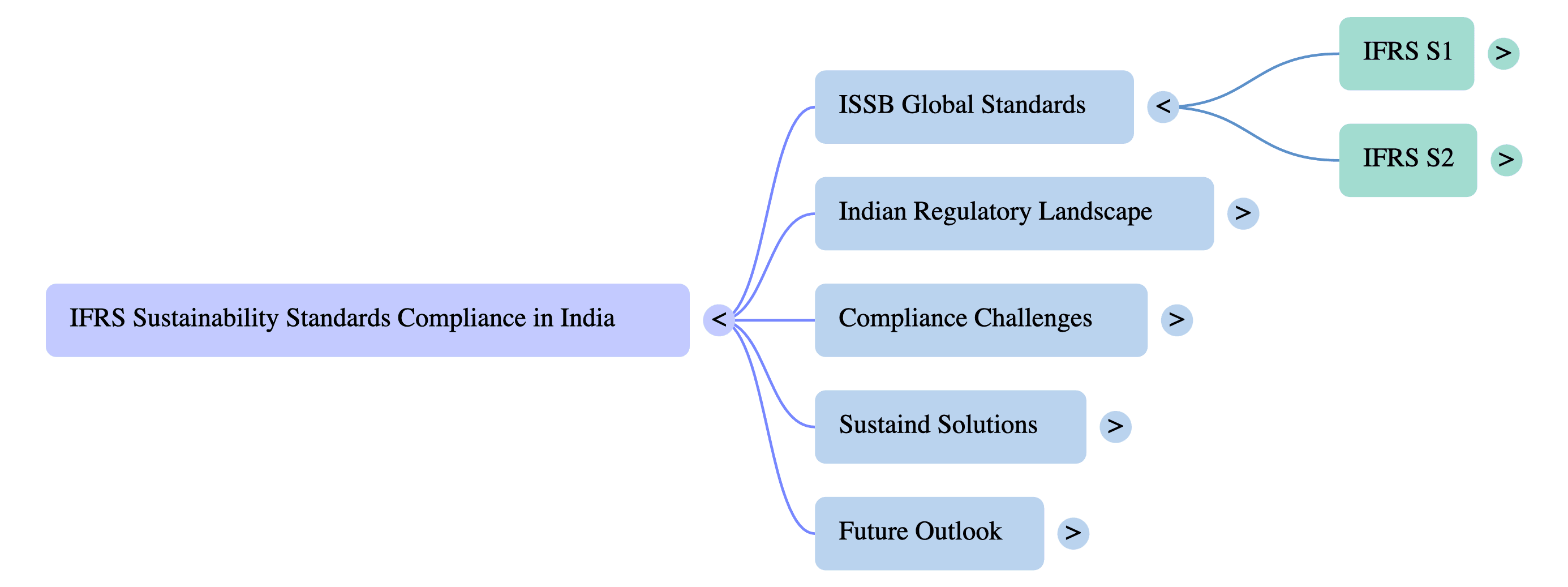
In June 2023, the ISSB officially released two foundational standards that have since reshaped how companies report on sustainability globally. IFRS S1 sets out general requirements for the disclosure of sustainability-related financial information, requiring companies to communicate any sustainability risks and opportunities that could reasonably be expected to affect their cash flows, access to financing, or cost of capital over the short, medium, or long term.
IFRS S2 drills deeper into climate-specific disclosures, drawing heavily from the Task Force on Climate-related Financial Disclosures (TCFD) framework. It asks organisations to disclose their governance structures, climate-related risks and opportunities, climate-scenario analysis, and Scope 1, 2, and 3 greenhouse gas emissions. Together, these two standards form the global baseline for sustainability reporting — a foundation that national regulators, including India's, are increasingly aligning with.
India's ESG Disclosure Journey: BRSR and Beyond
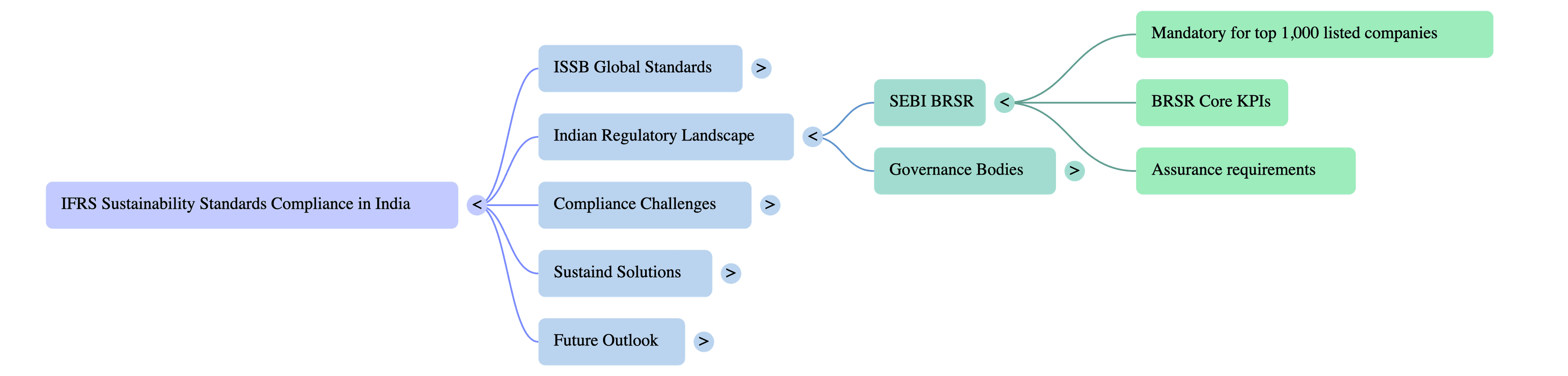
India's own sustainability reporting journey is anchored in the Business Responsibility and Sustainability Report (BRSR), introduced by the Securities and Exchange Board of India (SEBI). Initially mandated for the top 1,000 listed companies by market capitalisation from FY 2022-23, BRSR is now a cornerstone of India's ESG reporting architecture.
In 2023, SEBI introduced the BRSR Core — a subset of high-priority, quantitative Key Performance Indicators (KPIs) for which assurance is required. This includes metrics on energy consumption, water usage, greenhouse gas emissions, employee well-being, and supply chain disclosures. Crucially, SEBI has been closely tracking the ISSB frameworks, and future iterations of BRSR are widely expected to align even more explicitly with IFRS S1 and S2.
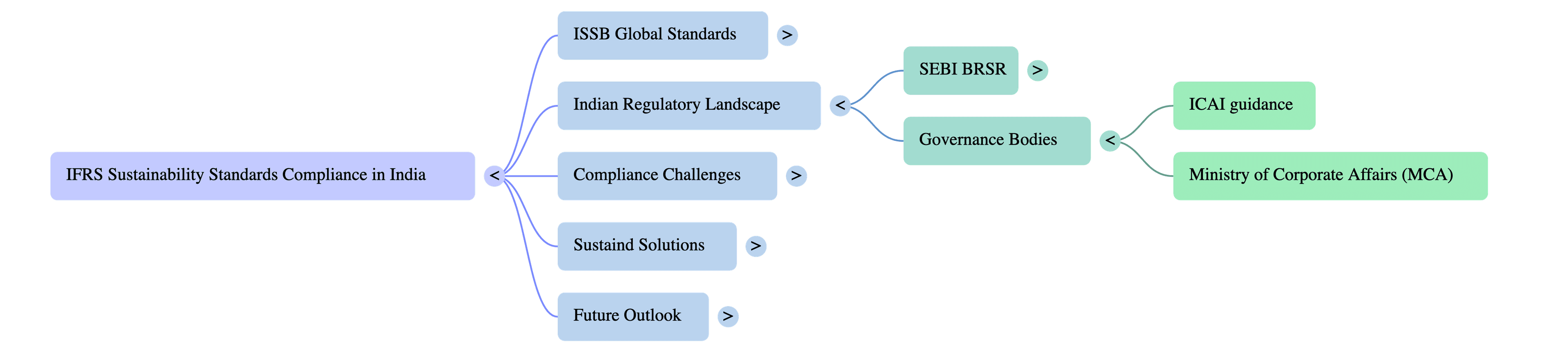
The ICAI (Institute of Chartered Accountants of India) has also published guidance on sustainability reporting, and the Ministry of Corporate Affairs (MCA) has been consulting on integrating ISSB-aligned requirements into Indian law. The direction of travel is unmistakable: India is moving towards full adoption of or equivalence with IFRS sustainability standards, and the timeline is tightening.
Key Compliance Challenges for Indian Businesses
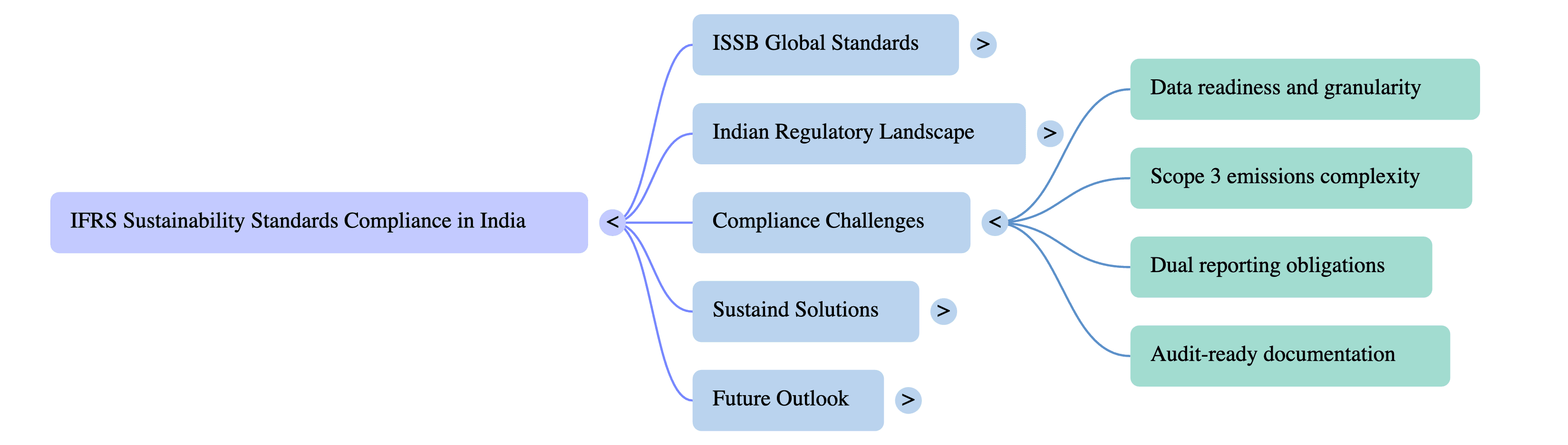
Navigating this evolving landscape presents a distinct set of challenges for Indian organisations:
-
Data Readiness: IFRS S1 and S2 require granular, auditable data across environmental, social, and governance dimensions. Many Indian companies, especially mid-sized enterprises, lack the internal systems to collect and verify this data consistently. Data Readiness: IFRS S1 and S2 require granular, auditable data across environmental, social, and governance dimensions. Many Indian companies, especially mid-sized enterprises, lack the internal systems to collect and verify this data consistently.
-
Scope 3 Emissions Complexity: Tracking value chain emissions is notoriously difficult, requiring deep supplier collaboration and robust methodology. For Indian companies with complex, multi-tiered supply chains, this remains one of the biggest compliance hurdles. Scope 3 Emissions Complexity: Tracking value chain emissions is notoriously difficult, requiring deep supplier collaboration and robust methodology. For Indian companies with complex, multi-tiered supply chains, this remains one of the biggest compliance hurdles.
-
Dual Reporting Obligations: Companies listed on both Indian and international exchanges face the challenge of simultaneously complying with BRSR, IFRS sustainability standards, and potentially other regional frameworks such as the EU's CSRD. Harmonisation is improving but not yet seamless. Dual Reporting Obligations: Companies listed on both Indian and international exchanges face the challenge of simultaneously complying with BRSR, IFRS sustainability standards, and potentially other regional frameworks such as the EU's CSRD. Harmonisation is improving but not yet seamless.
-
Assurance Requirements: With SEBI mandating limited assurance for BRSR Core metrics — and reasonable assurance likely to follow — organisations need to engage qualified assurance providers and build audit-ready documentation processes well in advance. Assurance Requirements: With SEBI mandating limited assurance for BRSR Core metrics — and reasonable assurance likely to follow — organisations need to engage qualified assurance providers and build audit-ready documentation processes well in advance.
The ISSB Adoption Roadmap: Where India Stands
As of 2025, more than 30 jurisdictions have announced plans to adopt, reference, or require ISSB-aligned standards. India has signalled its intent to align with the ISSB framework, with the MCA and SEBI both actively monitoring global adoption patterns. A phased approach is anticipated, similar to how India transitioned to Ind AS (Indian Accounting Standards aligned with IFRS financial reporting standards) — beginning with large listed entities before cascading to smaller organisations.
Indian companies would do well to treat this not as a distant compliance deadline but as an immediate strategic opportunity. Early adopters gain credibility with ESG-focused investors, reduce the risk of rushed, error-prone reporting, and build internal capabilities that deliver long-term competitive advantage.
How Sustaind Helps Indian Businesses Achieve IFRS Sustainability Compliance
At Sustaind, we understand that sustainability compliance is not just about ticking regulatory boxes — it's about building credible, decision-useful disclosures that resonate with investors, customers, and regulators alike. Our team of ESG specialists brings deep expertise in both Indian regulatory requirements and global frameworks including IFRS S1, IFRS S2, GRI, and TCFD.
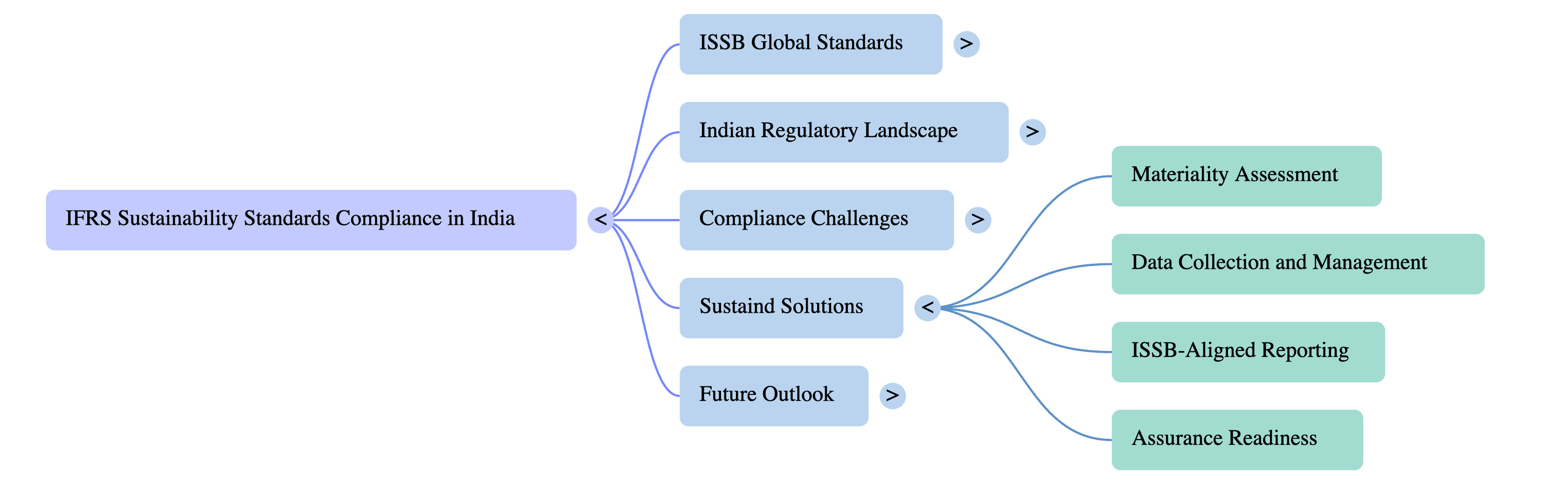
Sustaind supports businesses across the entire sustainability reporting lifecycle:
-
Materiality Assessment: Identifying which sustainability risks and opportunities are financially material to your business — the foundation of any IFRS S1-aligned disclosure. Materiality Assessment: Identifying which sustainability risks and opportunities are financially material to your business — the foundation of any IFRS S1-aligned disclosure.
-
Data Collection & Management: Establishing robust systems and processes for gathering environmental, social, and governance data across your operations and value chain. Data Collection & Management: Establishing robust systems and processes for gathering environmental, social, and governance data across your operations and value chain.
-
BRSR & ISSB-Aligned Reporting: Preparing disclosure-ready reports that satisfy current SEBI mandates while positioning your organisation for seamless ISSB adoption. BRSR & ISSB-Aligned Reporting: Preparing disclosure-ready reports that satisfy current SEBI mandates while positioning your organisation for seamless ISSB adoption.
-
Assurance Readiness: Preparing your documentation and internal controls for third-party assurance, reducing risk and enhancing stakeholder confidence. Assurance Readiness: Preparing your documentation and internal controls for third-party assurance, reducing risk and enhancing stakeholder confidence.
Looking Ahead: Sustainability Reporting as a Business Asset
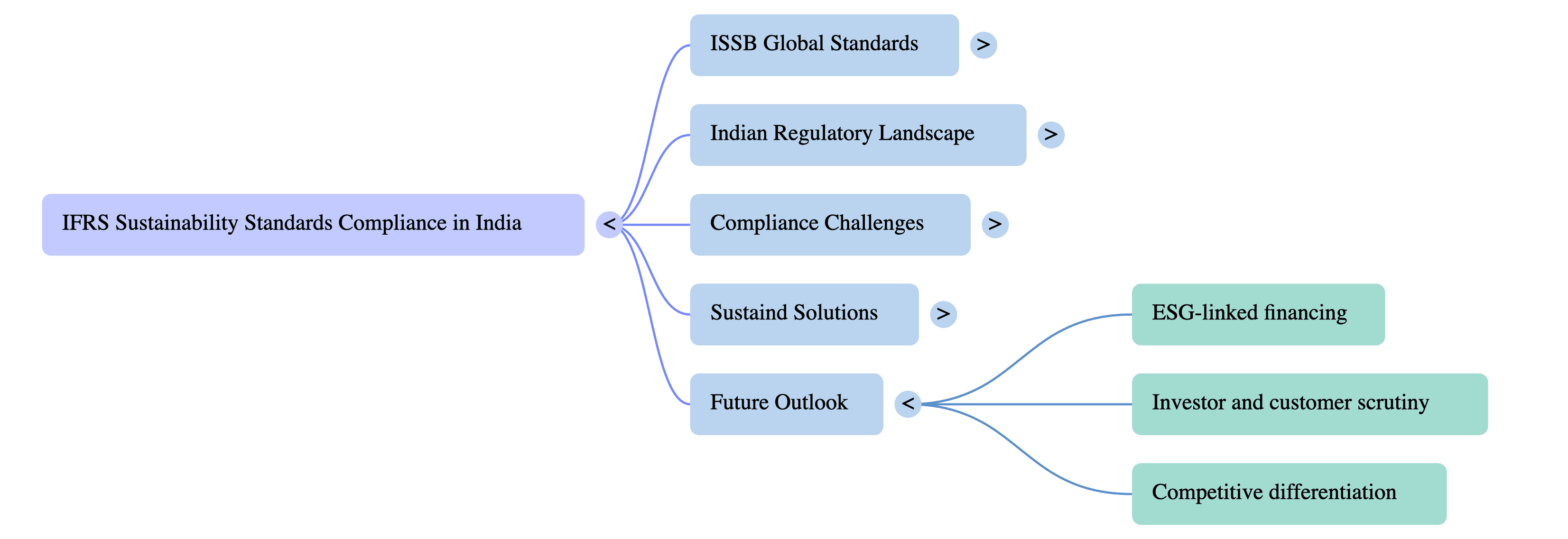
The narrative around sustainability compliance is evolving fast. What was once perceived as a
compliance burden is increasingly recognised as a source of competitive differentiation. ESG-linked financing is growing in India, with green bonds and sustainability-linked loans proliferating. Global institutional investors are applying ESG screens to their portfolios. And customers — particularly in B2B sectors — are scrutinising the sustainability credentials of their suppliers more closely than ever.
Companies that invest in building robust sustainability reporting capabilities today will be far better placed to attract capital, manage regulatory risk, and drive operational efficiencies tomorrow. IFRS sustainability standards compliance in India is not the finish line — it's the starting point of a long-term value creation journey.
Ready to future-proof your sustainability reporting?
Visit sustaind to discover how Sustaind can guide your organisation through IFRS sustainability compliance — from first assessment to final disclosure.