
- Climate Risk Assessment
- Sustainability Service As sustainability and financial transparency converge in the boardroom, Indian companies are increasingly grappling with two distinct but critical reporting mandates: IFRS (International Financial Reporting Standards) and BRSR (Business Responsibility and Sustainability Reporting). Understanding the IFRS vs BRSR reporting difference in India is no longer just a compliance exercise — it is a strategic imperative. At Sustaind, we work with businesses at every stage of their ESG journey, and one question we hear repeatedly is: "Are these two frameworks the same thing?" The short answer is no. And the long answer is what this article is all about.
What Is IFRS? A Quick Primer
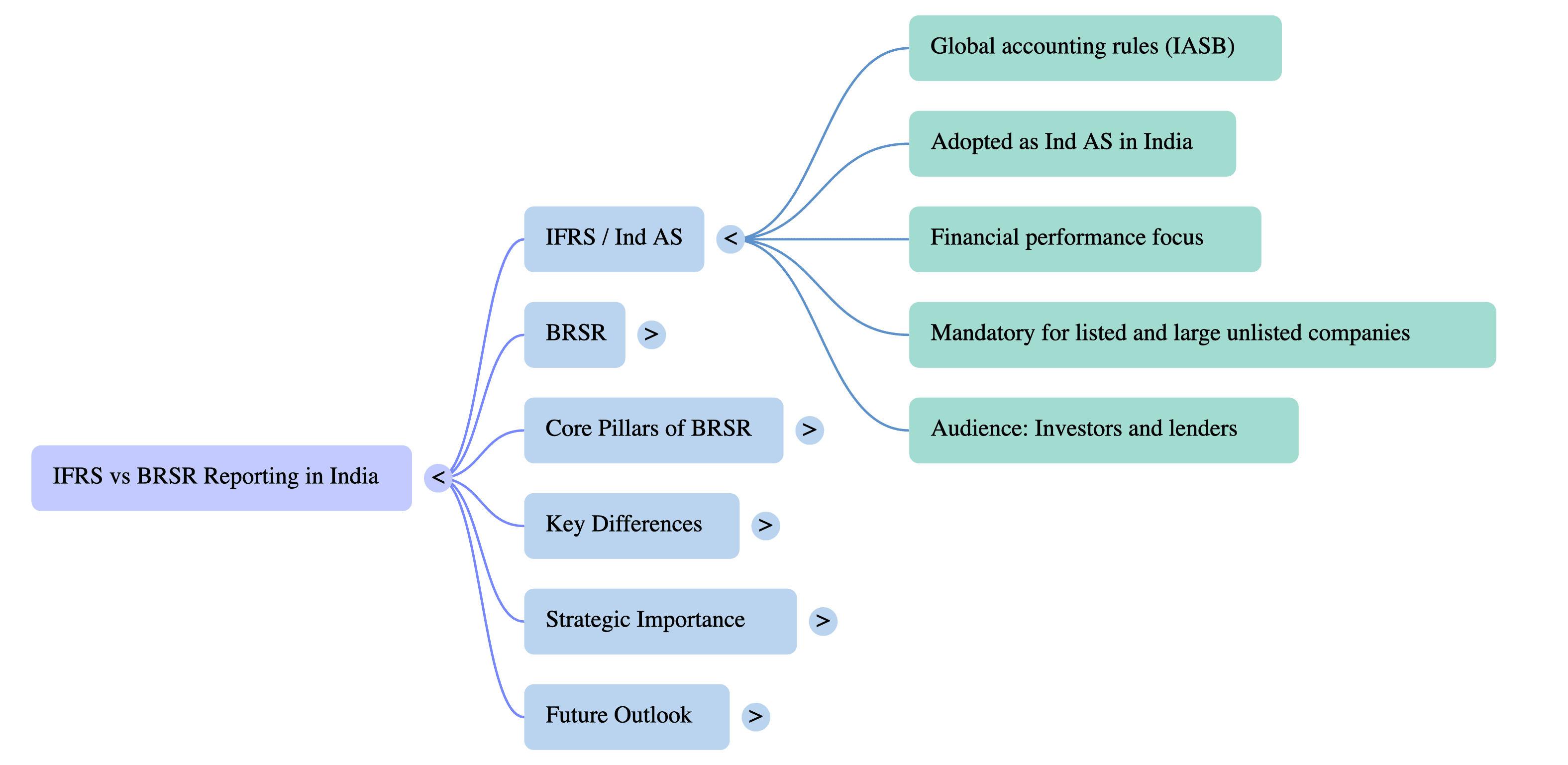
IFRS stands for International Financial Reporting Standards, a globally recognised set of accounting rules developed by the International Accounting Standards Board (IASB). In India, IFRS has been adopted through Ind AS (Indian Accounting Standards), which are largely converged with IFRS but tailored for the Indian regulatory environment.
Ind AS is mandatory for:
-
Listed companies and their subsidiaries Listed companies and their subsidiaries
-
Unlisted companies with a net worth of ₹250 crore or more Unlisted companies with a net worth of ₹250 crore or more
-
Banks, NBFCs, and insurance companies (with specific standards) Banks, NBFCs, and insurance companies (with specific standards)
The primary purpose of IFRS / Ind AS is to ensure that financial statements — the balance sheet, profit & loss account, cash flow statement — are prepared on a consistent and comparable basis, enabling investors and lenders to make informed decisions. (Read More: IFRS S1 S2 Sustainability Disclosure India)
What Is BRSR? India's Sustainability Reporting Standard
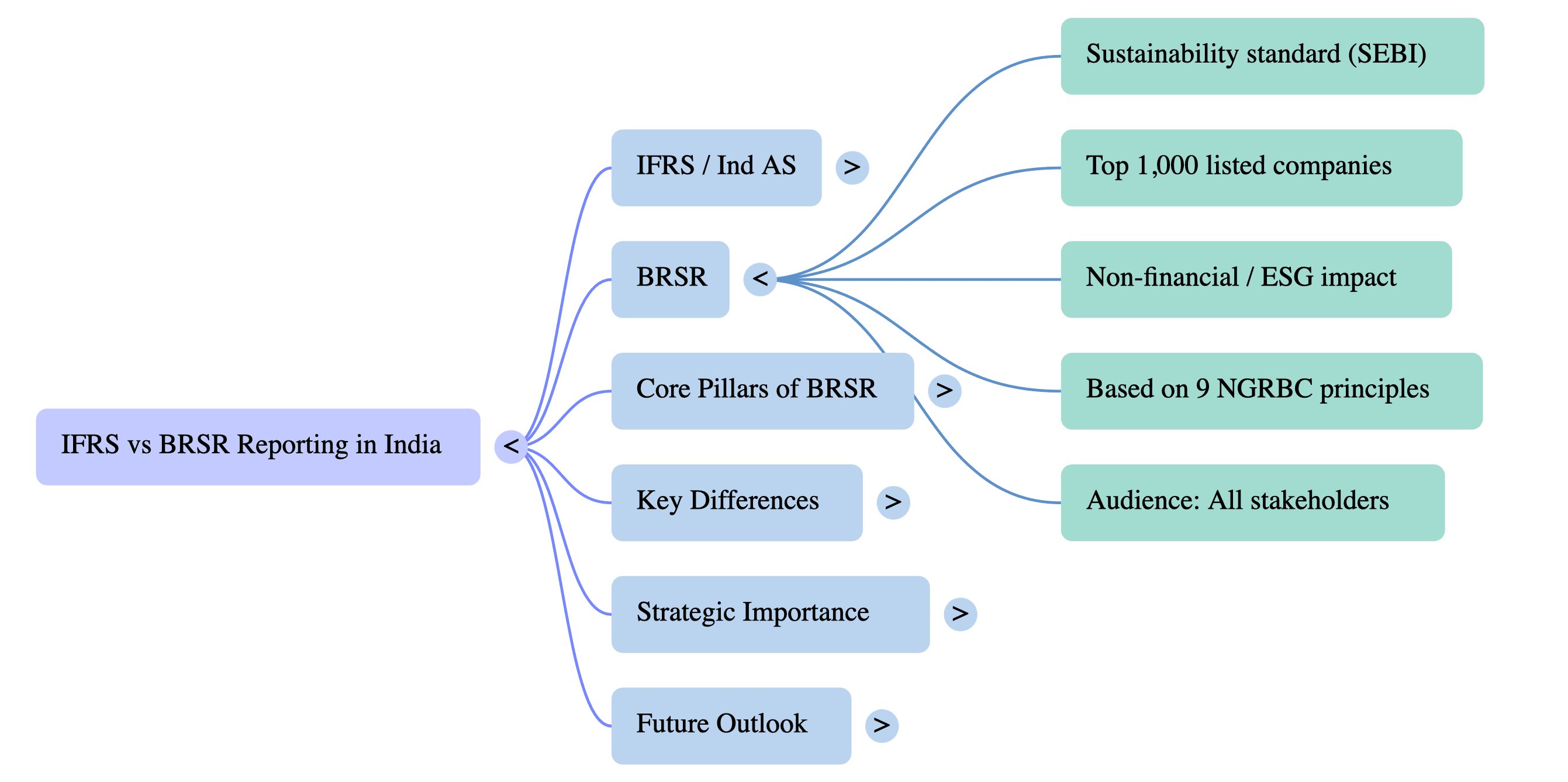
BRSR stands for Business Responsibility and Sustainability Reporting. It was introduced by the Securities and Exchange Board of India (SEBI) in 2021 and became mandatory for the top 1,000 listed companies by market capitalisation starting from FY 2022-23.
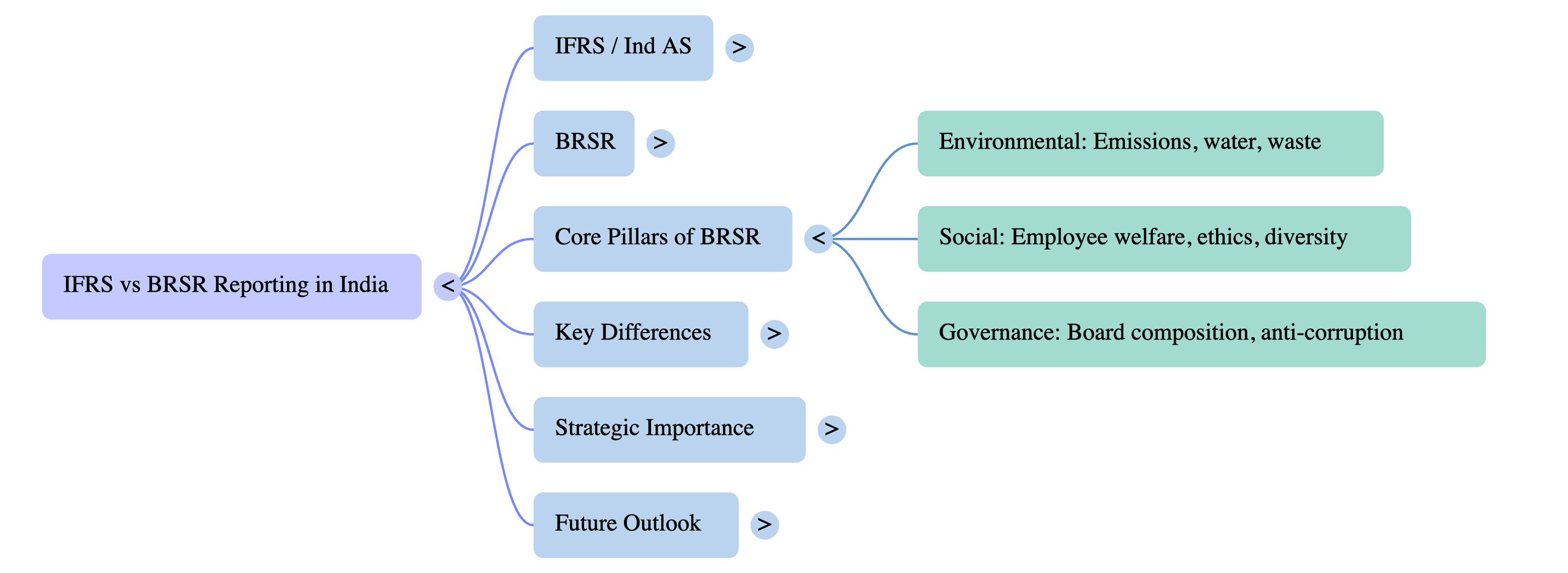
BRSR is structured around nine principles of the National Guidelines on Responsible Business Conduct (NGRBC) and covers disclosures across three broad pillars:
-
Environmental — greenhouse gas emissions, water usage, waste management, energy consumption Environmental — greenhouse gas emissions, water usage, waste management, energy consumption
-
Social — employee well-being, supply chain ethics, community engagement, gender diversity Social — employee well-being, supply chain ethics, community engagement, gender diversity
-
Governance — board composition, transparency, anti-corruption policies, data privacy Governance — board composition, transparency, anti-corruption policies, data privacy
Unlike IFRS, BRSR is not about rupees and paise. It is about the non-financial impact of a business — its footprint on people, the planet, and society at large.
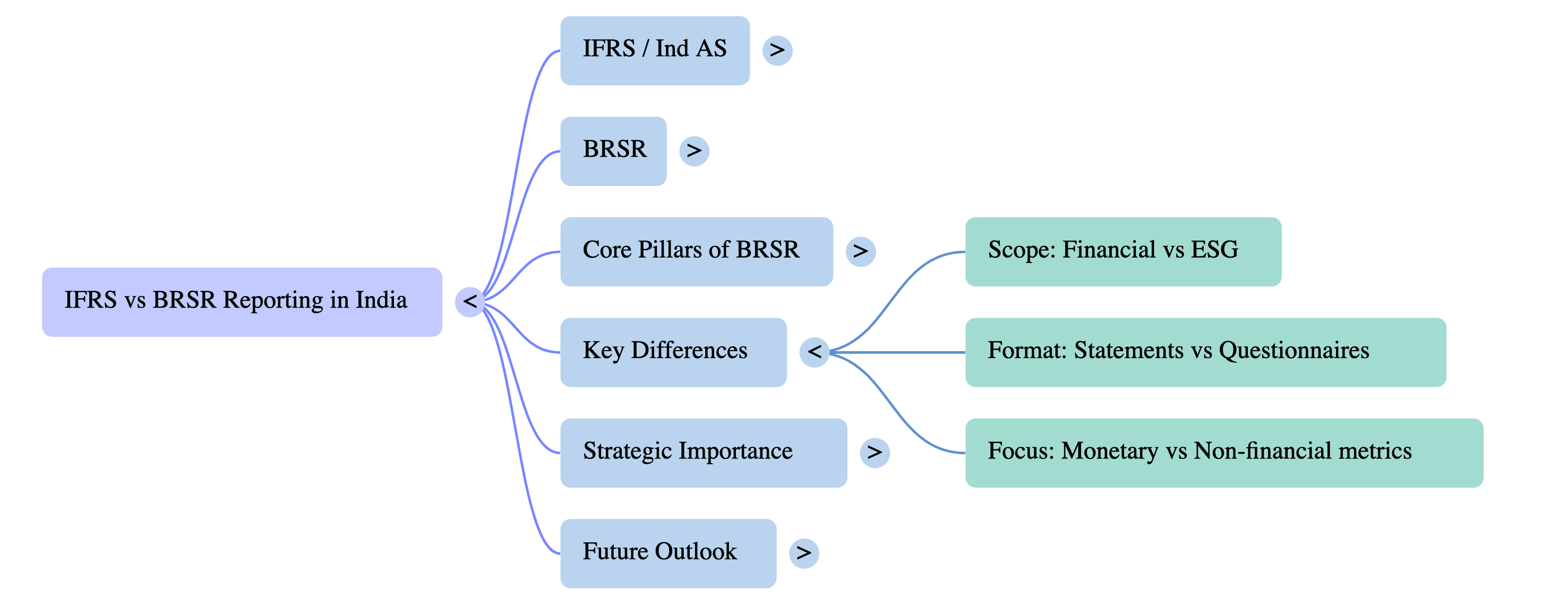
IFRS vs BRSR Reporting Difference in India: Side-by-Side Comparison
Intl. Financial Reporting Standards
Business Responsibility & Sustainability Reporting
Financial performance & position
ESG — environmental, social, governance
Applicability in India
Banks, NBFCs, listed entities (Ind AS aligned)
Top 1,000 listed companies (mandatory)
Non-financial / sustainability metrics
Phased from 2016 (Ind AS)
Investors, lenders, regulators
All stakeholders incl. employees & communities
Structured questionnaire-based report
Why the Two Frameworks Must Coexist
One of the most common misconceptions we encounter at Sustaind is that BRSR is a "replacement" for or an "extension" of IFRS. It is neither. The two frameworks serve entirely different purposes and together they provide a holistic picture of corporate health.
Here is why both matter in today's reporting environment:
-
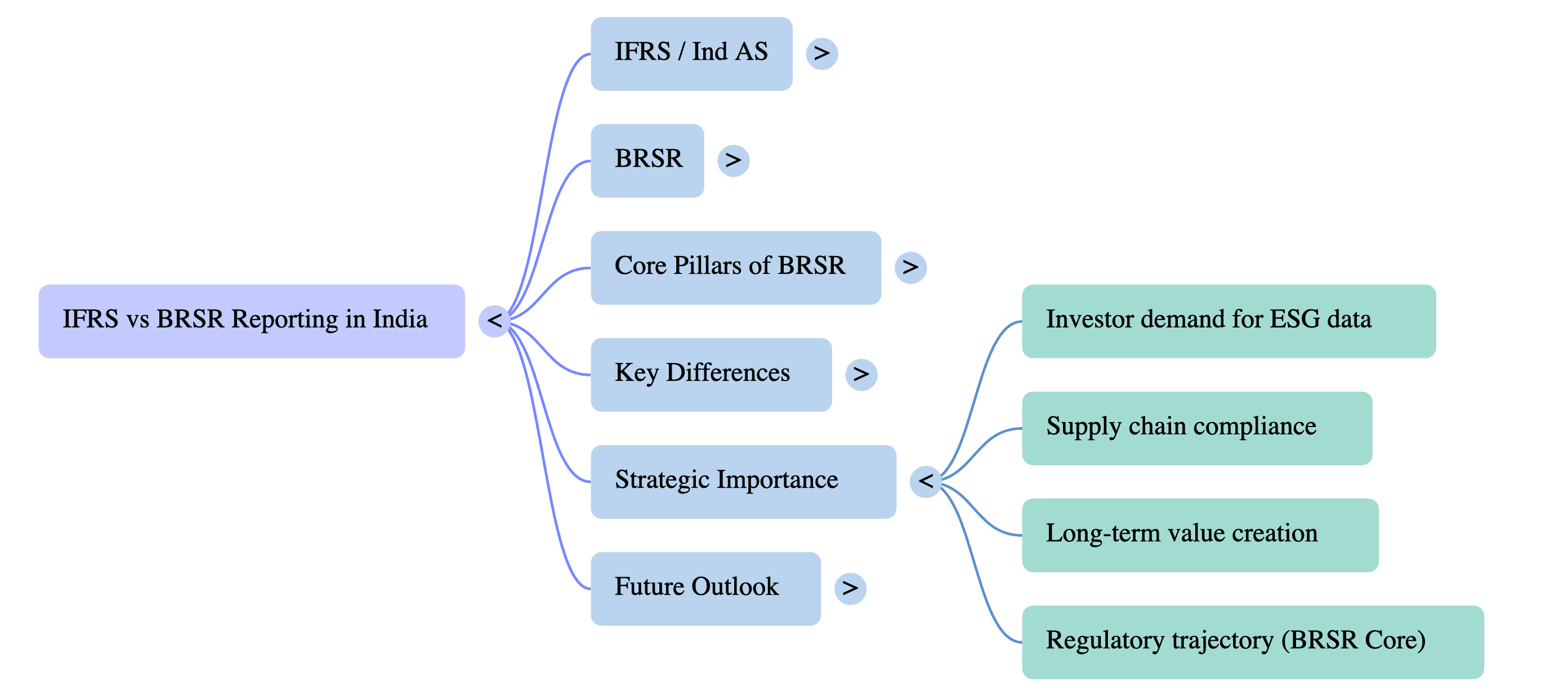
Investor demand: Global investors increasingly use both financial and ESG data to evaluate risk. A company with strong Ind AS financials but poor BRSR scores may face higher cost of capital. Investor demand: Global investors increasingly use both financial and ESG data to evaluate risk. A company with strong Ind AS financials but poor BRSR scores may face higher cost of capital.
-
Regulatory trajectory: SEBI has indicated that BRSR Core — a subset with assured disclosures — will be progressively expanded. IFRS S1 and S2 (sustainability-related financial disclosures) from the ISSB are also being watched by Indian regulators. Regulatory trajectory: SEBI has indicated that BRSR Core — a subset with assured disclosures — will be progressively expanded. IFRS S1 and S2 (sustainability-related financial disclosures) from the ISSB are also being watched by Indian regulators.
-
Supply chain compliance: Multinational buyers and investors are asking Indian suppliers for ESG disclosures. BRSR-aligned reporting gives exporters a competitive edge. Supply chain compliance: Multinational buyers and investors are asking Indian suppliers for ESG disclosures. BRSR-aligned reporting gives exporters a competitive edge.
-
Long-term value creation: Companies that manage ESG risks effectively tend to outperform financially over time, linking the two frameworks through value creation logic. Long-term value creation: Companies that manage ESG risks effectively tend to outperform financially over time, linking the two frameworks through value creation logic.
BRSR Core vs BRSR: What Has Changed?
SEBI introduced BRSR Core in FY 2023-24 for the top 150 listed companies, with mandatory third-party assurance. This subset focuses on Key Performance Indicators (KPIs) with quantifiable, comparable data — similar in spirit to the way Ind AS mandates auditability in financial reporting.
Sustaind helps companies prepare not just for basic BRSR compliance but also for BRSR Core assurance — bridging the gap between narrative sustainability reporting and verifiable, audit-ready disclosures. (Read More: IFRS Sustainability Standards Compliance in India)
The Road Ahead: IFRS Sustainability Standards (ISSB) in India
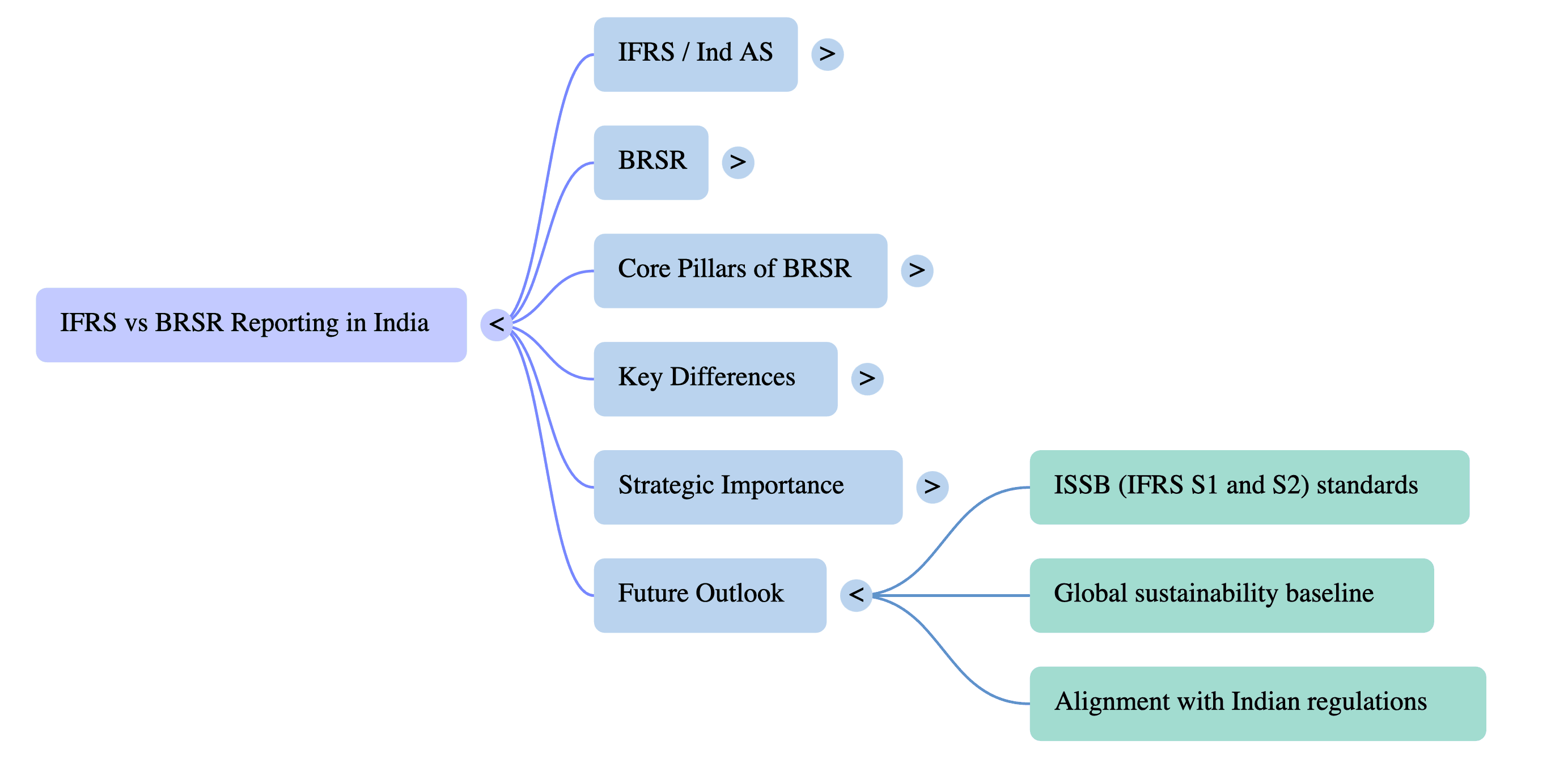
The International Sustainability Standards Board (ISSB), under IFRS Foundation, released IFRS S1 (General Requirements for Sustainability Disclosures) and IFRS S2 (Climate-related Disclosures) in 2023. These standards aim to do for sustainability reporting what IFRS did for financial reporting — create a global baseline.
India is actively monitoring ISSB developments. SEBI has stated that BRSR is India's response to global sustainability reporting trends, and future alignment with ISSB standards is a natural evolution. For companies already reporting under BRSR, transitioning to ISSB-aligned disclosures will be significantly easier.
How Sustaind Can Help
Whether you are a listed company navigating your first BRSR filing, a subsidiary aligning with Ind AS, or a mid-sized enterprise preparing for future ESG mandates, Sustaind offers end-to-end support:
-
BRSR gap assessment and materiality analysis BRSR gap assessment and materiality analysis
-
BRSR Core KPI quantification and assurance readiness BRSR Core KPI quantification and assurance readiness
-
ESG data management systems aligned with ISSB and GRI standards ESG data management systems aligned with ISSB and GRI standards
-
Training and capacity building for sustainability and finance teams Training and capacity building for sustainability and finance teams
-
Integrated reporting that bridges financial (Ind AS) and non-financial (BRSR) disclosures Integrated reporting that bridges financial (Ind AS) and non-financial (BRSR) disclosures
Visit us at Sustaind. to learn more about how we are making sustainability reporting simpler, smarter, and more impactful for Indian businesses.
The IFRS vs BRSR reporting difference in India is not a matter of one being superior to the other they are complementary lenses through which a company's true performance can be assessed. IFRS / Ind AS captures financial reality. BRSR captures societal and environmental reality. Together, they define the full picture of a responsible, resilient, and well-governed enterprise.
As India moves towards integrated reporting and global ESG standards gain traction, companies that master both frameworks today will be the ones leading tomorrow. Sustaind is here to make sure you are one of them.