
- Climate Risk Assessment
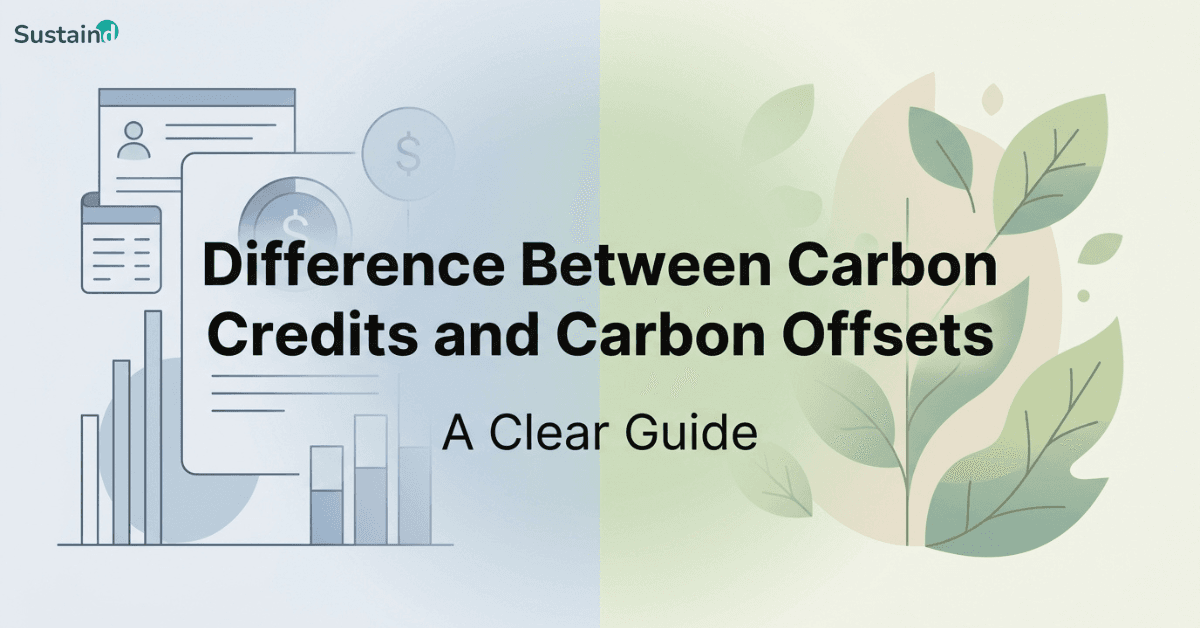
- Sustainability Service If you have been following sustainability conversations lately, you have probably heard the terms carbon credits and carbon offsets being used — sometimes interchangeably, sometimes in entirely different contexts. The difference between carbon credits and carbon offsets is a question that comes up constantly among businesses, policymakers, and individuals who are trying to make sense of the climate action landscape. While the two concepts are closely related and often overlap, they are not the same thing. Understanding the distinction matters more than ever, especially as carbon markets grow and climate commitments become part of everyday business strategy. At Sustaind, we believe that clarity drives better decisions — so let us break this down in plain language.
What Are Carbon Credits?
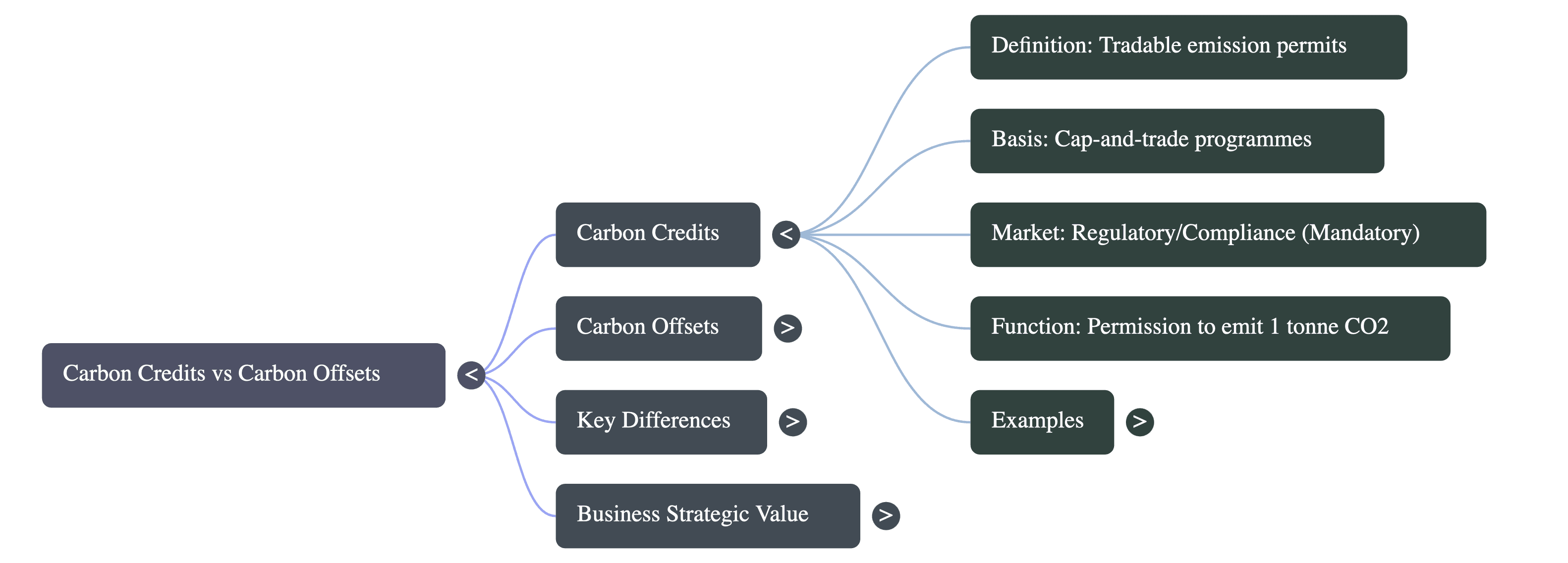
A carbon credit is a tradable certificate or permit that represents the right to emit one metric tonne of carbon dioxide (CO₂) or its equivalent in other greenhouse gases. Carbon credits exist primarily within regulatory or compliance-based systems, the most well-known being cap-and-trade programmes.
Also Read: How Do Carbon Credits Help Companies Meet Their Net Zero Targets?
Here is how it works: a government or regulatory body sets a cap — a limit on the total amount of greenhouse gases that a group of companies or industries can emit within a given period. Each company is allocated a certain number of credits. If a company emits less than its allowance, it can sell its surplus credits to another company that has exceeded its limit. If it emits more, it must buy additional credits or face penalties.
The key characteristic of a carbon credit is that it is a permission to pollute within a regulated framework. It does not necessarily represent a reduction in emissions that has already happened — it represents a ceiling enforced by regulation.
Examples of carbon credit systems include the European Union Emissions Trading System (EU ETS) and California's Cap-and-Trade Program. In India, the Carbon Credit Trading Scheme (CCTS), introduced by the Bureau of Energy Efficiency, is laying the groundwork for a structured domestic carbon market.
What Are Carbon Offsets?
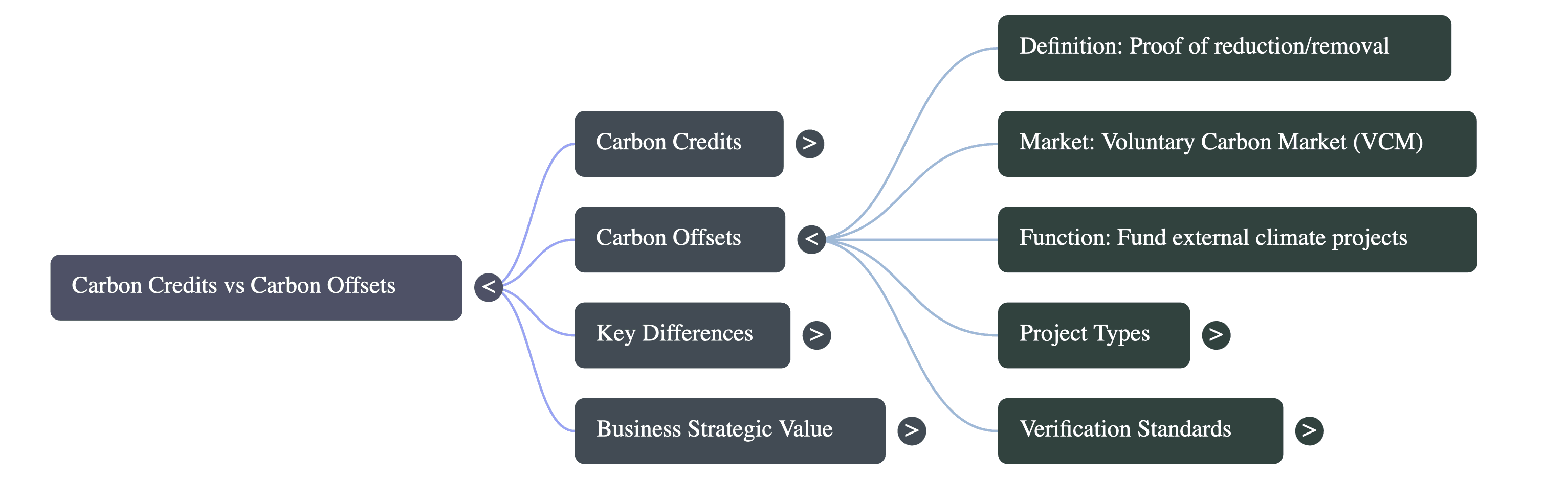
A carbon offset, on the other hand, represents a reduction or removal of greenhouse gas emissions that has already taken place elsewhere. When an organisation or individual purchases a carbon offset, they are essentially funding a project that avoids, reduces, or absorbs CO₂ — and in return, they claim an equivalent reduction against their own emissions footprint.
These projects can take many forms:
-
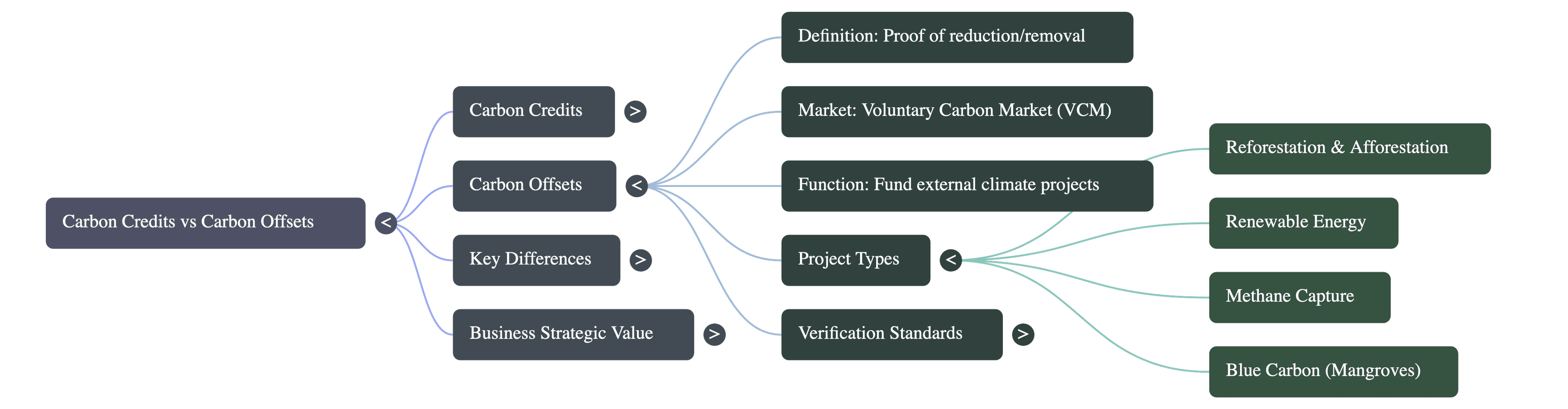
Reforestation and afforestation — planting trees that absorb CO₂ from the atmosphere Reforestation and afforestation — planting trees that absorb CO₂ from the atmosphere
-
Renewable energy projects — solar, wind, or hydro installations that displace fossil fuel use Renewable energy projects — solar, wind, or hydro installations that displace fossil fuel use
-
Methane capture — collecting and burning methane from landfills or agricultural waste Methane capture — collecting and burning methane from landfills or agricultural waste
-
Improved cookstoves — reducing wood burning and smoke in developing communities Improved cookstoves — reducing wood burning and smoke in developing communities
-
Blue carbon projects — protecting mangroves, wetlands, and seagrasses Blue carbon projects — protecting mangroves, wetlands, and seagrasses
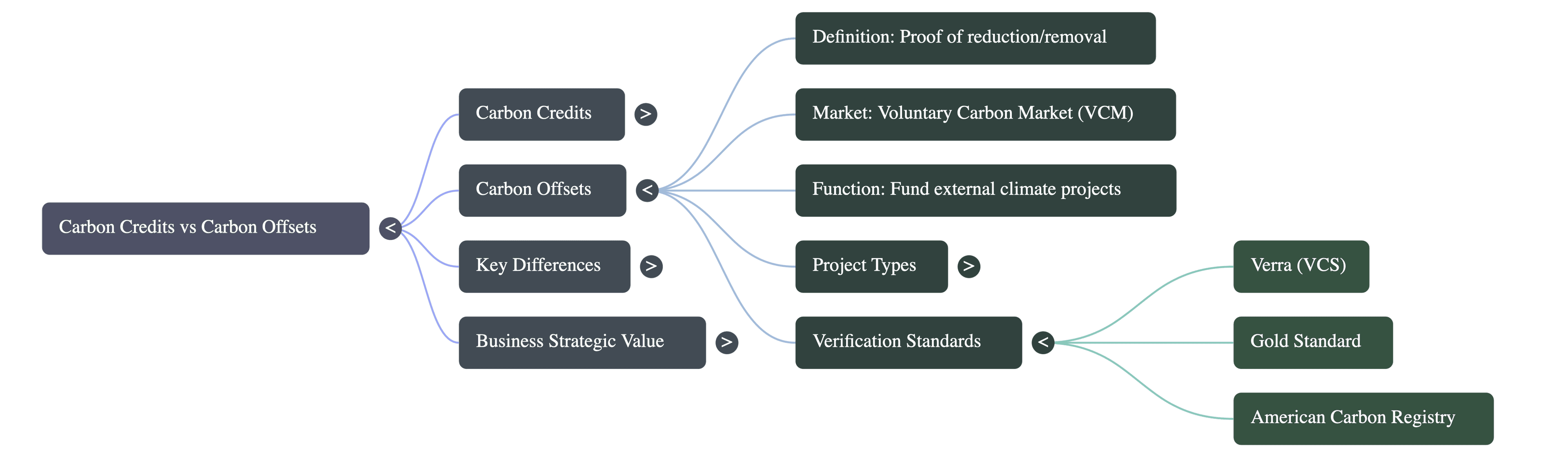
Carbon offsets operate largely in the voluntary carbon market (VCM), meaning companies and
individuals choose to purchase them beyond any regulatory obligation. They are typically verified by third-party standards such as Verra's Verified Carbon Standard (VCS), Gold Standard, or American Carbon Registry.
Key Differences at a Glance
Regulatory / compliance market
Voluntary carbon market (VCM)
Permission to emit within a cap
Proof of emission reduction elsewhere
Compliance (mandatory)
Voluntary (or compliance-linked)
Actual emission reductions/removals
Regulated industries under a cap
Businesses & individuals seeking net-zero
A reforestation project in Assam
Where the Confusion Comes From
The reason people conflate these two terms is understandable. First, offsets can be used to generate credits in some compliance markets — so the two systems do interact. Second, the language of climate action is still evolving, and even news outlets frequently misuse the terms.
Additionally, in some regulatory frameworks, verified offset projects can earn credits that are then sold on compliance markets. In this case, a carbon offset project generates carbon credits — blurring the boundary. But structurally, the mechanisms remain distinct: one is a permission, the other is a proof.
Why the Distinction Matters for Your Business
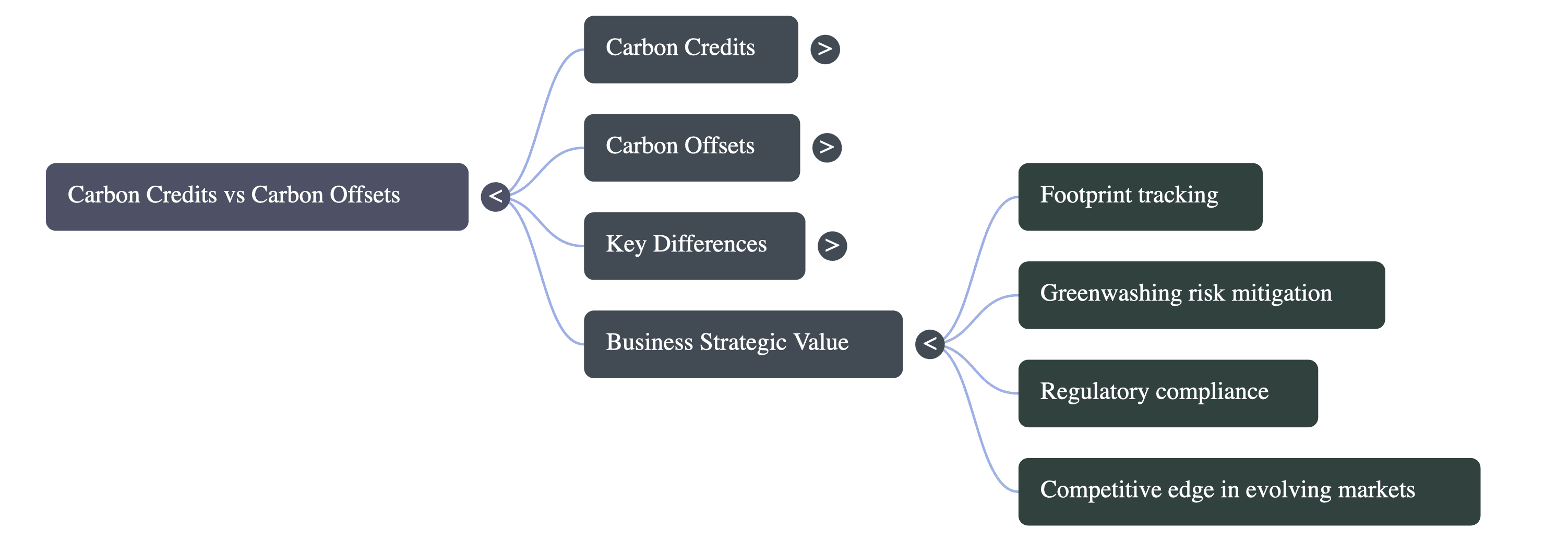
Whether you are a startup founder, a sustainability officer, or an entrepreneur thinking about your environmental footprint, understanding these concepts is not just academic — it is strategic.
-
If your sector falls under a regulated cap, you will be dealing with carbon credits (Also Read: How to buy carbon credits in India) directly — trading, purchasing, or strategising around your allowances. If your sector falls under a regulated cap, you will be dealing with carbon credits (Also Read: How to buy carbon credits in India) directly — trading, purchasing, or strategising around your allowances.
-
If you are pursuing a voluntary net-zero or carbon-neutral claim, you will most likely be buying carbon offsets to compensate for emissions you cannot yet eliminate. If you are pursuing a voluntary net-zero or carbon-neutral claim, you will most likely be buying carbon offsets to compensate for emissions you cannot yet eliminate.
-
Greenwashing risk is real — companies that misrepresent offset quality or conflate the two can face reputational and legal consequences. Greenwashing risk is real — companies that misrepresent offset quality or conflate the two can face reputational and legal consequences.
-
India's emerging carbon market means the rules are evolving fast. Staying informed gives early movers a competitive edge. India's emerging carbon market means the rules are evolving fast. Staying informed gives early movers a competitive edge.
At Sustaind, we work with businesses across India to make sense of these frameworks — whether that means helping you track your carbon footprint, identify credible offset opportunities, or prepare for India's evolving compliance landscape.
To put it simply: carbon credits are about staying within a regulated limit, while carbon offsets are about compensating for emissions by funding real-world climate solutions. Both play important roles in the broader effort to decarbonise economies, but they serve different purposes and operate in different markets.
As climate commitments tighten globally — and as India's own carbon market matures — knowing the difference between carbon credits and carbon offsets will become an essential part of any serious sustainability strategy.
- Sustainability Consultant